Redwood City Eichlers / Radiant heat
The slab · The first question a good buyer asks
The floor is the heating system.
Atherwood is among the earliest Eichler tracts built with heating tube cast into the concrete rather than a furnace and ducts. Seventy-five years on, that is the single largest variable in what one of these houses is worth.
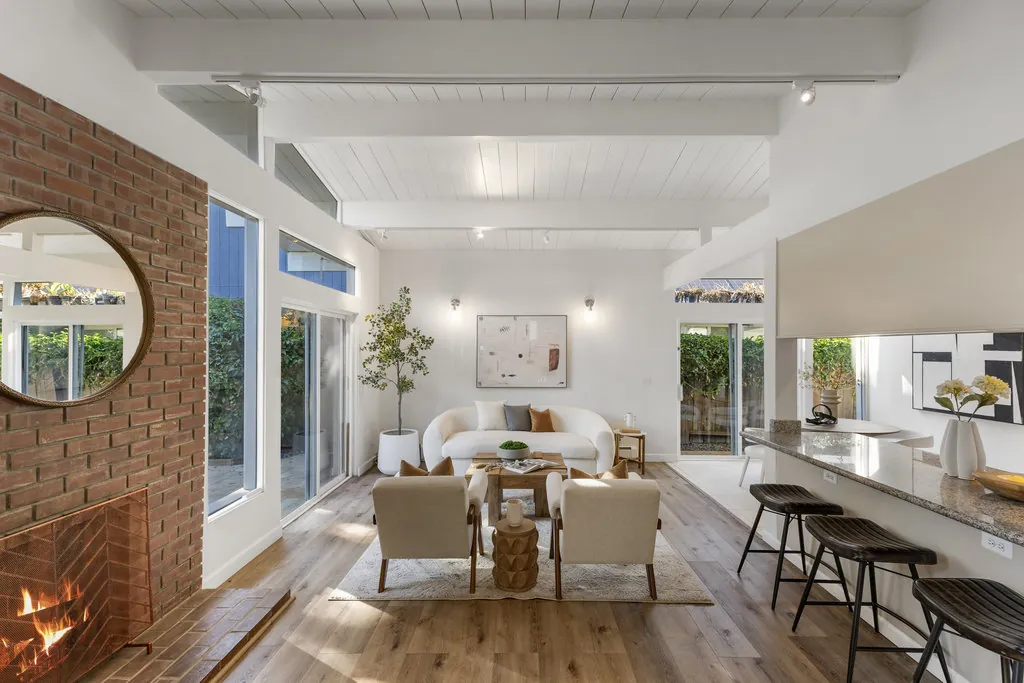
Why it was there in the first place.
It is not a luxury feature. It is what made the architecture possible. Take the heat out of the air and put it in the floor and you no longer need ducts; with no ducts you do not need an attic; with no attic the roof deck can be the ceiling; and with the ceiling doing structural work, the walls stop being load paths and can be glass. The warm floor is upstream of everything people love about these houses.
What actually fails
Original systems used steel tube in some houses and copper in others. Steel corrodes from the inside; copper is more forgiving but not immune, and either can be damaged by a slab crack or a later saw cut for plumbing. Failures are usually slow — a zone that stops heating, then a second one — rather than dramatic.
Plenty of these systems are still running. Plenty have been abandoned. Both are normal, and the honest position is that nobody can tell you which you have from the street.
How to find out
Run it and watch it with a thermal camera. A working system shows the tube runs as clean warm lines across the floor within twenty minutes or so. Dead zones show as cold fields. It is an inexpensive test and it is the one inspection we would never skip on a house here.
Ask for the boiler's age and service history, ask whether any zone has been valved off, and ask directly whether the sellers heat the house with it today. That last question gets a more useful answer than any of the others.
When it goes
Three routes owners actually take:
- Re-tube
- New PEX in a thin pour over the existing slab. Preserves the experience. Raises floor height, which has knock-on effects at doors and thresholds.
- Mini-split
- Ductless heads. Least invasive and adds cooling, which these houses never had. Visible indoor units are the trade, and they are visible in rooms designed around uninterrupted planes.
- Ducted heat pump
- Zoned air. Comfortable and modern. Needs somewhere to run duct in a house built specifically so it would not have to.
We took the third route at 1156 Parkwood Way — a four-zone heat and air system. We would make the same call again on that house and we explain why on its page, including what was lost.
Talk to us
Not sure whether your slab is still working?
Tell us the street and what you are seeing. We have been through this on our own house and on other people's.